Mix it Up!

If I had to homeschool the same way every single day, I confess to you, I would be bored out of my mind. I am sort of a free-spirited chick who can handle routine for a certain period of time, but needs to mix it up once in a while. Okay, I am routine about homeschooling in the mornings, but it doesn’t have to be done the exact same way. Like this…

I wanted the kids to be outdoors. The sun was bright and shining. The grass was oh, so green. So I set up a table outdoors, brought out chairs, and a rug for the younger kids to enjoy. It made the morning so much more invigorating. Of course, the kids were sweating like anything, but they got their work done like good little homeschoolers.

Whenever I give my learning styles talk to parents, I always say, “Prioritize the love for learning.” Children are natural learners, but they don’t always learn in the way we want them to. So be willing to adjust your teaching — whether it be mode of delivery, content, environment, disposition, etc. A child who enjoys his learning experience is highly motivated and easy to teach. But if you force-fit kids into a one-size-fits-all approach to learning, it is very likely that you will get frustrated with their responses.

I wanted my son to make a collage-like painting of what the Philippines means to him and he hated the idea. He was like, “I don’t want to do that. I don’t know what to paint.” I thought it was a great idea! After all, painting is sooo fun. Well, it is to my second son, who likes to do art. But to my older son, it was like bleck. So, I suggested that he pour different colored sand into a glass bottle to show the “colors of the Philippines.” Well, that appealed to him and he did that without my assistance and it turned out beautifully.

What’s my point? When teaching your children, don’t be afraid to mix it up so you can get your goals of instruction accomplished. If your kids are having fun while homeschooling, you will finish your checklist of things to learn and get done by the end of the year (maybe even earlier).

Look at Edan’s serious face…deep in thought about Sing, Spell, Read, and Write. And there is Elijah’s head while he reads his Civics.

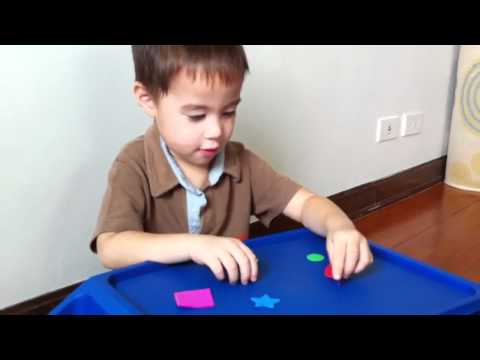
And here is Titus, putting red magnets on his eyes.

Edan is sweating, but doing great!

Making Mini Books

Children need a compelling reason to write. I remember having a conversation with author of Ultimate Guide to Homeschooling, Debra Bell, and she said that a person must have an audience to write.

Well, my second son, Edan, asked me to make him a book so he could draw and write in it. I stapled bond paper together and he got to work. I had no idea what he was up to but he wrote an drew pictures for his own little book. He called it a book about The Bible and the Created World.

When he presented it to me, I was pleasantly surprised with the amount of thought an insight he put into it. He is just six but he has a heart for God. I was blessed to read what he wrote. He asked me for some spelling help, but the ideas were all his. His grammar was not perfect but it’s a good start for him.

Downloadable Homeschool Portfolio Forms

I made these forms years ago when I was helping out with TMA Homeschool as a consultant. If you are making a portfolio for your child, these forms will make it easier for you. Just download and print.

Homeschool Portfolio Forms Part 1

Homeschool Portfolio Forms Part 2

Homeschool Portfolio Forms Part 3

Homeschool Portfolio Forms Part 4

Stress-free Homeschooling

I never wanted to be the kind of mom that loses her temper or sounds irritable around her children. In fact, I did not even think I had it in me. Having grown up with an extremely patient mom and an emotionally steady father sort of made me believe I would genetically end up the same way. However, this has been far from true. There have been times when I have expressed irritation toward my kids and God showed me that there is absolutely nothing good in me. None of us can inherit being controlled by the Holy Spirit by osmosis. It is a conscious choice and effort that we must make every single day – walking by the Spirit.

But it is not just about walking by the Spirit. We all need to come up with a game plan for the responsibilities and roles we have to juggle. Each of our circumstances warrants a different “tactical” approach to managing stress. For example, one mother’s stress of homeschooling and meeting the demands of a part-time job is unlike the stress of a mother who is homeschooling a high school student and has forgotten everything she used to know about physics and advanced mathematics!  In my case, it is the stress of raising four young children, homeschooling, , discipling a group of ladies, giving seminars and talks, ministry activities, running the household, and most importantly, being a helpmate to my husband.

Even though each of our situations as moms may be unique, I’m sure you can all relate to the fact that we have a long list of responsibilities and roles that we cannot run away from fulfilling. And when all these responsibilities and roles collide at the same time, it can be overwhelming, to say the least! This is when emotions start to heighten and if we are not careful, we can turn into our very human selves – the kind of moms that are stressed out and stressing everyone else out

But here is the good news.  Just as stress can be triggered by our surroundings, the pressures, and the burdens we have to bear, stress can also be avoided. While I am not an expert at stress management by any measure, having four kids has necessitated the need for me to come up with tactical measures so that I can be a better mom, better wife, and better servant of the Lord. I believe that one of the Devil’s strategies is to make us feel like we are a slave to our personalities, that we cannot change, that our circumstances are really too much to bear. But I also believe that God does not want us to live a defeatist life. He wants us to experience the abundant life as he says in John 10:10.

I would like to share with you simple stress avoidance tactics that have worked for me and hopefully, you can take what applies to your situation and make it work for you, too.

Tip # 1:  As often as possible, sleep early and wake up early. If you find yourself rushing into the activities of the day, give yourself some extra time every morning by waking up earlier. But the key is to sleep early so you are well rested. My doctor friend suggested no later than 11 PM because your body repairs itself between that time and 2 AM. Also, studies show that sleeping well keeps you from gaining weight! Do you know that you will die sooner without sleep than without food? You can’t go 10 days without sleeping!

Tip # 2: Re-charge your battery.  Personally, I get recharged by alone time. Even though this may not seem possible with so many children, it is! I have a little strategy for this. After breakfast (which ends by 8 AM), the kids shower, brush their teeth, and play together. They know that by 9 AM we start homeschooling. So before then, I go to my room and have alone time to read my Bible, take a nice shower, read or write. Sometimes, I even get to take a short nap! Since the kids are busy playing, reading their Bibles or practicing violin, I don’t need to entertain them.  This time allows me to charge up my battery for the day. In the afternoons, I also encourage my kids to nap. Two of them are past the napping age, but it can’t hurt to let them get at least an hour of quiet and rest. Besides, I treasure my afternoon peace!

Re-charging your battery is about doing activities that energize you. Some moms need to be with other moms. Others need their cup of coffee, the parlor, or some shopping once in a while. Whatever it is, make time for activities that you enjoy doing (as long as they aren’t excessive or immoral!). Homeschool moms don’t have to be haggard-looking or 10 years old than their age!

Of course the best way to re-charge is to rest in God’s presence. If you have time to, please read A Life of Rest, A Life of No Limits and Psalm 27.

Tip # 3: Get fit and fabulous with your husband and kids. In the past, pregnancy and breastfeeding gave me excuses to give myself “treats.” But these treats did not contribute anything good to my life. In fact, before I started exercising again, I had 33% body fat!  Even though I didn’t gain a lot of weight during my pregnancy, all the junk happily became fatty tissue in my body. Ugh! Yuck!

Edric and I finally got into an exercise routine. We would run three times a week. We still do this. Honestly, I don’t like running, but Edric motivates me because he is so disciplined about it. And I have seen the benefits of exercise. My mind is clearer. My energy levels are higher. I also have greater self-discipline.

The apostle Paul saw the connection between physical fitness and spiritual fitness. Physical discipline helped him to stay spiritually focused and faithful.

1 Corinthians 9:26-27 26 Therefore I run in such a way, as not without aim; I box in such a way, as not beating the air; 27 but I discipline my body and make it my slave, so that, after I have preached to others, I myself will not be disqualified.

Family fitness is easier to do when there is like-mindedness and accountability between you and your spouse. Imagine a household where one spouse wants to eat all the lechon, chicharon, chocolate, spam and where the other one wants to be organic and vegetarian. (And, no, we aren’t vegetarian. We are somewhere in between!) It just won’t work.  So decide on a fitness routine and meal plan that you can do together as a family. And please don’t tempt yourself by buying junk food and sweets for the kids. If it’s in the house, it’s too accessible!

Tip # 4: Train your kids to be self-directed and independent learners. It helps alot that my two older sons are reading well. My second is still on his way to becoming an excellent reader, but I don’t have to mirco-manage him all the time. They both have pretty good comprehension, too. Because of this, I can assign them tasks and they can do quite a bit of work on their own.

Raising children who love reading begins with us, as parents. Reading with your kids, letting them see you reading, and making reading fun are ways to get your kids on the path to reading on their own. Of course, using a solid phonics program for pre-schoolers helps alot, too.

Tip # 5: Don’t be pushy. I’m not saying that we shouldn’t encourage hard work in our kids, but as an example, I won’t force Elijah to write a paragraph or story on a day when he has already done a lot of writing for other subjects. Why? I don’t want to kill the joy of learning in my kids. That is a higher value for me than finishing an assignment. Besides, he can write the paragraph later in the afternoon or the next day. Homeschooling gives us a lot of time to make up work that isn’t finished. That’s one of the things I love about it. And I absolutely refuse to be hostage to the daily lesson plan dictated by a curriculum. As homeschooling moms, we can set the end goals and make adjustments to the process. However, as a safeguard measure, interact and dialogue with your kids alot to find out if they are retaining information they learn. Can they answer your questions and formulate judgments and conclusions about what they are learning? This is important.

Tip # 6: Make homeschooling a lifestyle. A whole lot of learning happens when my kids are playing together, interacting with each other and others, exploring, inventing, reading independently, practicing music and piano, exercising, and accompanying us on trips, errands and various activities. Instruction time is about 2 to 3 hours, but learning doesn’t have to start and end during that period of the day. Class periods have programmed us to believe that education happens inside a classroom. But education can have so much more depth and dimension to it. Once a parent understands that homeschooling is a lifestyle of learning (and that children are learning all the time), the academic pressure eases.

I remember an occasion when our sons were watching a performance of students on stage. We were seated on the balcony and could see all the little heads bobbing up and down as the children danced and sang. Our kindergarten-aged, Edan, said, “There are 67 people on the stage.” I turned to look at my husband, Edric, for two reasons. One, I was surprised that Edan bothered to count everyone. And two, I was hoping Edric would verify if his counting was accurate. Well, it was. This pleasantly surprised me. This was math applied to real life. Do we do alot of counting drills at home? Not really. But we do play a lot of board games that require him to count and add up his points.

Tip # 7: Smile and laugh often. This may sound like silly advice, but it has helped me to be positive with my own kids. Learning should be fun! If I can’t smile or laugh while teaching, then something is wrong. I’m too uptight, not spirit-filled, or too focused on my goals. I am not enjoying the process. And if I am not enjoying the process, how can I possibly expect my kids to either?

Tip # 8: Be purposeful. When I was younger, I would easily say yes to speaking engagements and ministry activities. I would also take on projects thoughtlessly. It wasn’t until I attended a talk by Wayne Cordeiro that I learned the principle of the 5%. 95% of the things we do, others can do. Meaning, these are not my priorities. But there is the 5% that only I can do. Growing spiritually, being a wife, a mom, homeschooling, discipling the ladies I meet with, homemaking…These are part of my 5%. No one else can do these things for me. Everything else is second in importance.

Matthew 25 is a good reminder that we are all given a stewardship. God has not entrusted to us everything, but he has entrusted to us certain things. He expects us be faithful with these certain things. To Joy Mendoza he has entrusted the role of a wife, motherhood, homeschooling, and the mentoring of other women.

14 “For it is just like a man about to go on a journey, who called his own slaves and entrusted his possessions to them. 15 To one he gave five talents, to another, two, and to another, one, each according to his own ability; and he went on his journey. 16 Immediately the one who had received the five talents went and traded with them, and gained five more talents. 17 In the same manner the one who had received the two talents gained two more. 18 But he who received the one talent went away, and dug a hole in the ground and hid his master’s money.

   19 “Now after a long time the master of those slaves *came and *settled accounts with them. 20 The one who had received the five talents came up and brought five more talents, saying, ‘Master, you entrusted five talents to me. See, I have gained five more talents.’ 21 His master said to him, ‘Well done, good and faithful slave. You were faithful with a few things, I will put you in charge of many things; enter into the joy of your master.’

   22 “Also the one who had received the two talents came up and said, ‘Master, you entrusted two talents to me. See, I have gained two more talents.’ 23 His master said to him, ‘Well done, good and faithful slave. You were faithful with a few things, I will put you in charge of many things; enter into the joy of your master.’

When people ask me questions like, “Can you speak for this event. It’s for single ladies and the topic is relationships?”, it’s much easier for me to say, “I’m sorry. Thank you for considering me but I cannot commit to speak for your event.” Before, I would feel pressured to say yes. And then I realized, wait a second! There are so many women out there who can speak on this topic, who have more time to prepare for it and who can do a better job than I can! Saying no to opportunities or activities that are not part of my 5% has helped me to say yes to God’s calling and purpose for my life and devote my energies to the right priorities. Furthermore, Edric helps me determine what’s important. I channel schedule decisions through him so I get his input and seal of approval.

I am not only accountable for my preoccupations, I am also accountable my time. As much as possible, I refrain from scheduling appointments or doing errands before 12 Noon. Weekday mornings are devoted to homeschooling. It’s my job. When I make compromises with my morning schedule, the homeschooling work piles up for me and the kids. This can get stressful. But if I safeguard my weekday mornings, the kids and I are able to finish our goals by the end of the year.

Maybe you have a stress-buster idea or tactic that has worked for you. I would love to hear about it or include it in this list of tips. Let’s find stress-free solutions together!

The Listening Learner

Do you have a child that easily retains and remembers information that she or he hears? If so, you’ve got an auditory learner. These kinds of learners will enjoy dialoguing with you about their lesson and listening to you read a story or hearing you read about a topic.  My oldest son, Elijah, is very much an auditory learner. He is a listening learner, which is great because I can dictate, read, or talk with him and he can process that information.

The downside is that if he is in a room trying to work and his siblings are noisy, he has a very hard time concentrating. (The other downside for me, but upside for him is that he remembers everything I say…a whole lot better than I do!)

I find creative ways to accommodate his learning style. One way is to isolate him in a room with me so he can think when he has to do math or writing assignments. This helps him stay focused and engaged. Otherwise, he wants to be a part of every conversation and activity that he hears about.When it comes to his lessons, particularly Science, Local Civics, and History, I read aloud to him and ask him questions as I go along.

While it is pretty easy to teach him, the challenge is that I have four kids. And if I were to read aloud to all of my kids every single day, I would run out of saliva. Seriously. I read The Chronicles of Narnia to Elijah when he was five and my mouth would get parched. He would run to the kitchen and get me a glass of water so I could keep going, but it was tiring!

I was happy to discover some years back that many audio books of children’s literature and classics have been made by ingenious people. Not all books can be downloaded or played online, but once in awhile you discover a gem of a site with free audio books and it makes your day!

This evening we listened to the Velveteen Rabbit on Light Up Your Brain. This site has a few stories in MP3 format so they play on any audio device and of course, they are free. Kids can listen to each story and visit the story’s page, where they can read along.

For other audio book sites you can check out the following: (Please be aware that some of these sites have books for adults only)

Books Should Be Free

Lit 2 Go Adventure Genre

Audio Books for Free – Fiction Classics

Gutenberg: The Audio Books Project


Essential Pre-Math Skills

It is often easier for toddlers to understand a math concept if they experience it concretely first and if they can connect it to their daily life experiences.  I’ve seen this approach work with my kids. Therefore, I try to avoid worksheets when they are little until they have a good grasp of pre-math concepts. 

Checklist for your toddler:

  • Knows shapes and can identify shapes in his environment.
  • Identifies numbers (1 to 10 or more) and understands that numbers are symbols that represent how many. For example: * * * is 3.
  • Makes comparisons (ex. fewer or more)
  • Understands positions (inside and outside, left and right, left, middle and right, above and below, top and bottom, under)
  • Classifies based on attributes (ex. sorting by same color, same size, same texture, etc.)
  • Can follow a simple sequence or pattern
  • Familiar enough with local currency to identify 25 cents, 1 peso, ten pesos, etc.
  • Differentiates between size (long and short, tall and short, light and heavy, holds more or less, wide and narrow)

Ideas for you (videos):

Some examples of materials that encourage pre-math skills in our home: (Most of these images are linked. Just click on the image.)

Marbles as counters

Bath numbers and shapes

Magna Tiles

Shapes and Sorting - Turn the Wheel Book

Number Peg Board

Matching Shapes and Colors

Geometric Stacker

Magnetic Numbers

Beginner Pattern Blocks

Helpful Resources:

http://www.ixl.com/math/pre-k

http://www.kidsnumbers.com

How to teach position and direction

See also…Essential Pre-writing Skills and Homeschooling the Toddler Years


Homeschooling Video Demos (Part 3 to 5)

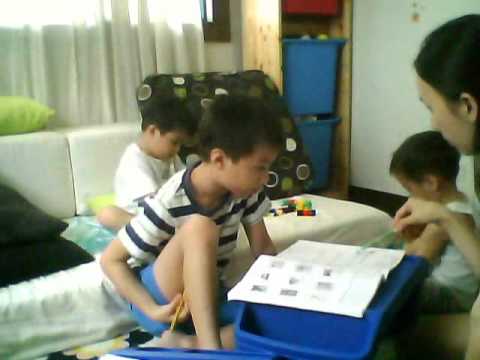
Homeschooling Young Children Part 3 shows me giving more attention to Elijah while Edan is assigned his Science. After a while, Edan wants me to help him color in his book so I do that. When he finishes, he decides it is time for a break by going over to play with Titus. I keep working with Elijah to supervise him. With Elijah, I don’t need to be so hands on, but I still need to check on his work and be available if he needs me. He is getting to be more independent so I don’t have to be hands-on all the time.

In Homeschooling Young Children Part 4 I ask Edan to read aloud without me and I concentrate on helping Elijah finish his work. I demonstrate how I ask Elijah questions to see if he knows the material he is studying. Sometimes Elijah prefers to answer orally.

Personally, I feel that it is good to allow children to express themselves verbally instead of writing down answers all the time.  Homeschooling gives me the opportunity to interact with my kids to find out if they are learning. This is an advantage that homeschooling allows. In a classroom, a teacher has to rely on written work most of the time because she cannot possibly connect with each student every single day in the same way that a mom can dialogue with their child while homeschooling.

After I have given time and attention to Elijah and Edan, I proceed to work with Titus with a manipulative material for shapes and fractions. Homeschooling Young Children Part 5

Since Titus is just 2 years old, my learning goals for him are much simpler. I want him to enjoy the homeschooling environment, music, art, and reading time; I want him to feel like he is included; I want him to learn more about God through Bible stories; I want to teach him character;  I want to reinforce his understanding of shapes, numbers, colors, pre-math concepts like bigger, smaller, longer, etc., develop his motor skills by using some Montessori-style activities, and introduce him to phonetics. He also learns a lot from observing, interacting with, and copying his older brothers.


Homeschooling Video Demos (Part 1 & 2)

People have often asked me, “What do you do when you homeschool?” “What is it like teaching more than one child?”

To answer these questions, I decided to put together videos of the kids and I while we homeschool. I took a video of our homeschooling interactions yesterday and then uploaded them. Don’t have grand expectations. These are raw, candid and unprofessional, and you will see the kids disrupting each other or not being angelic ALL the time. I left the videos as is so that you can have an idea of how homeschooling happens for us. I hope it will demystify things and help you realize that learning happens naturally (not perfectly) but the kids enjoy the process and move towards completely their goals.

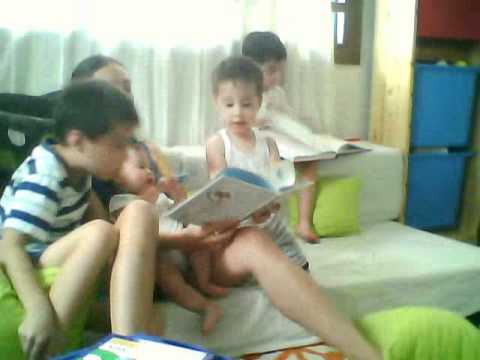
Homeschooling Young Children Part 1 shows me reading with all four kids around me. This time is really for the younger kids, but Elijah, my older son, joins in as well. I am reading to them from a character book called First Virtues for Toddlers by (for the sake of the younger kids), and then from a book called Right Choices by Kenneth Taylor. I also use a book called ABC Bible Verses for Kids and The Bible in Pictures for Little Eyes, which are both by Kenneth Taylor but you won’t see me reading from these in the video. All of these books work well for children from 0 to 4. They are not text heavy. (The ABC Bible Verses for Kids requires a longer attention span — ages 3 to 7)

In the video, Edan is sitting near me but not right beside me. I don’t make a big deal out of this. To include him in the story time, I ask him questions. He is one of those kids whom, more often than not, prefers to be doing something with his hands while I read.

Don’t stress out if your child doesn’t want to sit on your lap or right beside you while you read. As long as he is within hearing distance, that’s fine. Ask them questions about what you are reading to check for comprehension.

First Virtues for Toddlers by Mary Manz Simon

Right Choices by Kenneth N. Taylor

My ABC Bible Verses by Susan Hunt

The Bible in Pictures for Little Eyes by Kenneth Taylor

Homeschool Young Children Part 2 shows how I help them as they do their individual work. Edan is working on practicing reading using Sing, Spell, Read, and Write readers for Kindergarten. Elijah is supposed to be working on Language Arts and you will see him getting distracted from time to time and I remind him to keep focused. (He is currently using Alpha Omega Publications lifepacs for Language Arts.) Titus is given a building toy to play with so can stay preoccupied. Tiana is being entertained by the “Ate” or nanny.

Edan gets frustrated while he is reading some parts but I encourage him by saying, “Let’s see who can read the words first” (There is a list of words that he has to read at the beginning of the book). And I also say, “Let’s take turns reading.” so he doesn’t feel like he has to read the whole book. I’ve tried this technique with him on numerous occasions and eventually, he is willing to read the whole book on his own.

Sing, Spell, Read, and Write (SSRW) Kindergarten Level by Sue Dickinson


As you may see from the videos, our learning environment is laid back. The kids get to sit on the floor, on a carpet while they learn. I’m not particular about making them sit still at a desk but for some other parents, this is important. It is up to you to set up a learning environment that works for you and our kids. I prefer to have close contact with my children — either sitting beside them or near them. I don’t teach from a white board or blackboard.

Part 3 to 5 to follow…