My T.A.

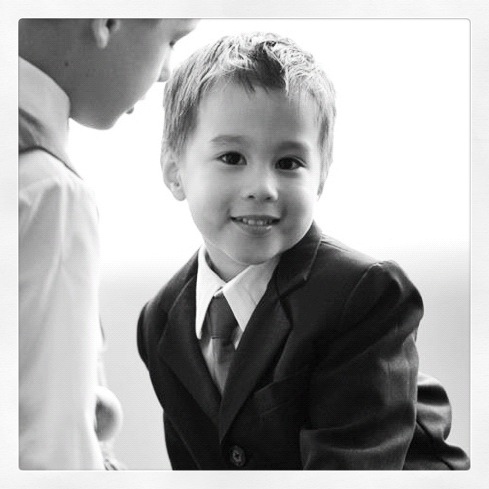
I have a teacher’s assistant, also known as Edan, my second son. He is an incredible help to me when it comes to homeschooling Tiana. With his methodical and systematic way of doing things, he comes up with activities for her to do when the others are homeschooling or like a good soldier, he will implement assignments that I delegate to him. Tiana calls him “Teacher Edan” during her lessons and what a relief it has been to have him preoccupy her so I can give attention to Titus when he needs one-on-one instruction.

I have told Edan many times how valuable he is to me. And the thing is, he really enjoys being a teacher. He gets a deep sense of fulfillment out of the experience and he is quite patient. Sometimes, he does get annoyed when Tiana doesn’t focus. But hey, she is like 2 years old. Her attention span is 5 minutes or less.

Today, I laughed when Edan said, “Mom, it is going to take Tiana ONE YEAR to learn all the things that you asked me to teach her!” She was a bit distracted when he was asking her to complete a pattern. But most of the time, he’s got her attention and she is participatory and engaged. The benefit to Edan is that he is learning communication skills and reinforcing his own knowledge of academic matter…not to mention putting character traits into practice.

Seeing my kids look out for each other is one of my delights as a homeschooling mom. It’s not easy to teach four kids who are at different levels and have varying needs, but Edan’s assistance provides me with daily encouragement. Multi-level homeschooling is so much easier when siblings contribute and help one another. Furthermore, I am realizing that children respond to the expectations you have of them. Whenever I see Edan volunteering to teach Tiana, I say, “You are such a great teacher, Edan!” It motivates him to live up to this positive label.

One time, a bunch of his cousins were coming over and he told me, “Mom, I am going to take care of all the younger kids. I will plan the games and activities. I will be in charge.” He named each one of the kids he was going to be responsible for. He left out Elijah and an older cousin because, according to him, they could fend for themselves.

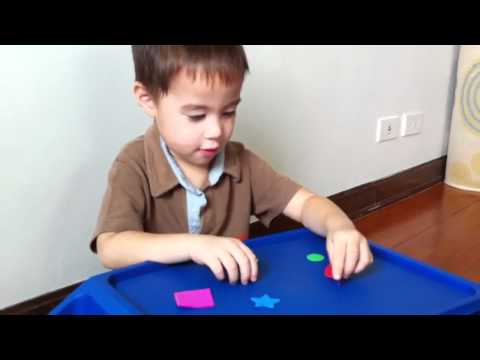
I took a couple of photographs of Tiana homeschooling under “Teacher Edan.” Some of the activities were ideas I learned from reading about the Montessori method.

Emoticon Tiana

Just for fun…

I asked Tiana to do facial expressions and I took a video of her. If you want a minute of entertainment to break up your day, watch this silly thing…

Emoticon Tiana

You can take the idea further and make expression cards using your toddler’s face. Take photos of your child and print them out. You can discuss them together to encourage language skills.


Happy Face

Sad Face

Surprised Face

Scared Face

Sleeping Face

Laughing Face

Praying Face

Shouting Face

Silly Face


Questions you can ask:

What kind of face does this show? When do you feel this way?
Can you show me what face you have when you are tired?
Which face shows you praying?

You can also say things like…
“When I see you, I feel happy!” Then show the happy face card.
“When you tickle me, I laugh!” Then show the laughing face card

You can also make a little book of expressions for your child.

Etc…

Balloon Color Lesson

Titus’ birthday balloons became an instant color lesson for my little girl. I let her play with colors and I helped her identify them. She’s still a long way from getting it, but these balloons provided a great hands-on color lesson. Homeschooling toddlers is so much fun!

Death by Popcorn?

Death by popcorn? Not quite. Just my Titus showing me his new way of eating popcorn. Yes, that’s my three year old…my creative, persistent, active child who is a constant source of entertainment. And with that kind of a personality comes the emotional, volatile, and moody side which needs guidance and leading.

For example, when he brought his ice pop into the master’s bedroom and onto our bed, I said to him, “Hon, no eating on the bed.” He replied, “But look, mom, it’s in my mouth.” He showed me how there was no possible way to make a mess with his method of sucking on the ice pop. “I still want you to get down and not eat on the bed.” Titus inched over to the edge of the bed and said with a smirk, “I’m not eating.” And it was true. He was “drinking” his ice pop. He wasn’t eating anything. (Smarty pants!) “Okay, but you still have to do that off of the bed” was my response. He did obey but this was an example of how he tends to insist on his will over mine (We are working on this).

God gave me my Titus to teach me dependence and humility. I have had to lift up my son in surrender every time I reach the maximum human capacity meter for parenting a strong-willed child. And I have been brought to my knees in humility, recognizing how inadequate, unworthy, and clueless I am to raise a son who needs extra special attention.

Having a son like Titus has taught Edric and I how to be more sensitive to the needs of our children, and how to be more patient as we train them. Lately, we have stepped up our “game” by being more intentional with Titus. And it has been working.

Two days ago, Edric took him to buy Pixies Bangus for a dinner we had to go to. They bonded together as they waited for the fish to be cooked. Edric bought him a “special” juice drink. And when he got back to the rest of us, he said, “Dad bought me special juice and I really like it.” He went on to narrate about how he squeezed the glass of juice and it spilled on him, but that it was okay because he got to change his shorts. In the meantime, my two other sons asked if they could drink Titus’ “special juice” and he let them. I could tell he was very happy because he animatedly chatted about his glass of juice some more.

Another positive Titus moment was when Edric was teaching him how to pray. Titus used to have a difficult time praying. When it would be his turn to say grace, he would either mumble or not say anything. Edric decided to try a different tactic. During one of our family devotions, he picked Titus up and put him on his lap. While hugging him and holding him close he said, “Go ahead Titus, you pray.” Titus was quiet for a few seconds and then he spoke the sweetest prayer, “Dear Lord, please help us to memorize our verse. And please help Ging to come back.” (Ging is our househelp who went to the province for a long vacation.) I felt like crying when I listened to him pray. These were just simple words but they were heartfelt and sincere. Finally! A prayer that was all his! Edric and I talked afterwards about how holding him must have made him feel secure and confident.

Why were these seemingly small moments significant to me? Because Titus is sandwiched between two older brothers who are very close to one another and a baby sister who gets a lot of attention. So Edric and I make extra effort to make him feel equally loved and important.

My dear Titus is a constant reminder that God gives parents the grace to raise all kinds of children. Each one can be unlocked, discovered, trained and gently ushered in the direction God wants them to go.

When Titus showed me how to eat popcorn like a dog, it was God’s way of reminding me that I need to “chillax.” Have fun parenting Titus! Don’t force him into a mold! He has a God-ordained purpose. Enjoy and cherish him and his unique perspective on life, but keep training him in the way he should go. God will supply the grace and capacity!

What to Do When It Gets Ugly

There comes a stage or age in every child’s life when they will use whining and fussiness to get their way. After having four children, I have come to realize that no matter how cute they are as little babies, they eventually exhibit their self-centered perspective and it gets ugly. This perspective makes them believe that everything and everyone must cater to their whims and demands. Some are less vocal and demonstrative, or may not show it till later, but be sure that they will definitely act like the world revolves around them – their feelings, their wants and desires. It is at this point of exhibition that parents must cooperatively decide to make a stand against their child’s will, for their greater good.

I’ve had three boys go through this ugly period sometime between 10 months to 3 years. Each one responded to our correction, training, and discipline differently. And each one had their own way of expressing self-centeredness. They would do things like sit on the floor and get angry, sulk their way around the house, whine and cry, run to their yaya or nanny, or use force to get their way. Edric and I knew that these behaviors were not acceptable, but more so the mindset behind them. If we allowed any one of our children to remain this way, it would be to their own detriment. So we did our best to train them and weed out the ugly.

Here are some ideas that were beneficially applied in our household that I hope might help you, too:

1. Be clear about the “no fussing” rule. When a child doesn’t get his way and starts to whine, sulk, pout, cry, yell, or get physical, take him aside (carry him, if necessary, to a place where you can talk to him privately), look him square in the eye (go to their eye-level) and say in a calm but stern voice, “You are being fussy. Fussiness is not allowed in our family. You cannot act that way. If you do that again, I will spank you. You need to obey.”

As miraculous as it may seem, children are able to control their emotions, especially the wrong ones. I’ve seen my kids go from crying and wailing to absolute silence when they know they are in trouble. One of the keys is to make sure that children understand that there is a rule about having a bad attitude.

John Rosemond, America’s most widely read parenting expert, says, “The fewer words a parent uses when giving instructions or conveying expectations, the more likely it is that the child will obey.” He calls it the “Alpha Speech,” explaining that “the fewer words a parent uses, the more authoritative the parent sounds. The fewer words a parent uses, the more clear the instruction.”[1]

Alot of times, when we are instructing our children, we add “Okay” at the end of our sentence. “I want you to obey, okay?” This gives our children the impression that they have the option not to. I’m guilty of this at times. But as much as possible, Edric and I make it very clear to our children that obedience is imperative.

2. If you have explained your rule about no fussing and your child does it again, follow through with disciplinary action. Don’t say, “Okay, if you do it again, I really will spank you.” But remember to spank with the following guidelines:

  • You have a good relationship with your child, you’ve spent alot of quality time with him so that his emotional tank is full and he feels confidently loved by you.
  • Both you and your spouse are like-minded about spanking. There is no “good cop, bad cop” dynamic going on with your kids.   
  • You explained the rule clearly to begin with. Your child acknowledged you when you were explaining the boundary to him.
  • You will not spank in anger or irritation.
  • You will take him to a private place (We use the toilet or study room) so that he is not humiliated in public.
  • You explain what he did wrong and let him recognize what he did wrong.
  • You will use a flat wooden rod or belt that will not break the skin.
  • You give one to two significantly hard and painful swats on the rear end and not other parts of the body where you could break bones or cut skin. (We usually give one very hard one unless they fight back and we increase the number if they do.) If it is not painful, it will not be an effective consequence.
  • You hug him immediately after and tell him that you love him, that you only spank him when he disobeys because you are teaching him to obey.
  • You give him the opportunity to say sorry for what he did.
  • You repeat the rule again looking at him in the eye.
  • Your spouse reinforces the same rule as consistently as you do.

I need to add that we spank our children for only a few important things, mostly connected to disobedience and disrespect. For example, with Elijah, our eldest who is turning 9, we can count the number of times he was spanked on two hands.  By the age of 6 he didn’t really need spankings anymore. We use other forms of discipline, like withdrawal of privileges or natural logical consequences. Our second son, Edan, who is almost 6 had his share of spankings but seldom receives them now. Our third son, Titus, was spanked the most number of times and still gets spanked from time to time, but because he has learned to obey, spankings are also rare for him. The point is that Edric and I don’t carry a spanking rod around with us everywhere we go or have to use it all the time. But, we have very clear rules that we teach our children to obey and if they break them, they are disciplined for doing so.

Some people argue that spanking is abusive. It can be when it is for punishment purposes only, if it is done in anger, if rules are unclear, if a parent does not have a loving relationship with their child, if it is done in public to humiliate the child, or if it is done too often and randomly.  We avoid all of the above.

3. Everyone in the house must reinforce the rule and support it. Tell your househelp to report to you when your child does not obey the rule. They are not allowed to spank your children, but they can inform you when your child does not listen to them or acts up. This prevents your househelp from feeling helpless and frustrated. And it prevents children from manipulating them. Believe me, children will try to get their way with anyone who they perceive to be a weak link! This is why it is very important to be in agreement with your spouse — that both of you will have a consistent stand about rules in the home.

4. Have a loving relationship with your child, but don’t be too “buddy-buddy” with him. There is a difference between developing a close relationship with your child and relating to them like a friend. The friend to friend relationship will naturally happen if you have good communication with your children. However, when they are still young, they must see you as their authority. A loving, authoritative parent gives their children a sense of security. I like how one of my friends put it. “When you give limits to your child, it’s like putting your arms around them and embracing them.”

My parents were strict when my siblings and I were growing up. They were not unreasonable or exasperatingly strict, but they made us very cognizant about our boundaries. We knew what lines not to cross in terms of obedience and respect. Because of this we had a healthy fear of them. And since they were always affirming about how much they loved us in word and actions, we had no doubt that they made rules and enforced them for our ultimate good.

5. Don’t be overprotective of your kids emotions, especially the boys! This used to be an issue between Edric and I because I always wanted to baby the boys when they would get hurt. If they fell down, I wanted to run to them, pick them up and console them. Edric would tell me, “Don’t pick them up. Let them get up themselves and don’t pay too much attention to them.”  I didn’t agree with this at first, but it turned out to be great advice! Of course we would only do this if it wasn’t a MAJOR injury. Edric was right. The boys learned not to make a big deal about scrapes and cuts, which somehow toughened them up emotionally, too.

How does this relate to being fussy? Sometimes, we “massage” the emotions of our children too much and too often. We are sensitive to every cry and feeling they have, putting their emotions on some kind of pedestal. But, we forget to teach them emotional fortitude. They need to learn to master their emotions and respond to them appropriately versus becoming a slave to them.

6. Watch your child’s attitude and behaviour closely. I’m not talking about being a “helicopter parent” that hovers protectively over her children or micromanages everything they do. I’m talking about addressing heart issues immediately and not letting them fester or grow destructively. Fussiness in our home is a heart issue because it reeks of self-centeredness and pride, which is the root of sin. When a child’s fussiness, ill-temper, bad attitude, or poutiness is tolerated we allow him to develop these mentalities:  “I am more important than everyone else” or “I want what I want now!” or “I can act the way I want to even if it hurts others” or “Nobody can make me do what I don’t want to do” and so on…

7. Balance discipline with character instruction. How can we expect our children to mature spiritually and emotionally if we don’t prioritize the teaching of character in our homes? We cannot keep working on removing wrong attitudes and behaviour without pointing them in the right direction. When it comes to fussiness, we teach our children what it means to wait and to have the right attitude while doing so.  We would often tell them, “Change your attitude” or “Have a good attitude.”

“In everything give thanks; for this is God’s will for you in Christ Jesus.” I Thessalonians 5:18

When our second son was 2 years old, my mom caught him chanting, “Good attitude” to himself when he was about to get upset about something. She also saw him change his frown into a smile when he said it. He used to be quite negative and moody but training him made a big difference. We have told our boys that when we say, “Change your attitude,” it means they need to turn their frown or pout into a smile. Have you ever tried smiling when you are angry or upset? It does wonders to change your mood!

8. Do not give in to your child’s demands until they stop having a bad attitude. I’ve seen my mom do this with all her grandchildren. If they whine about something, she will tell them, “Stop whining first.” Or, “Wait and I will give it to you later.”  This is a good option if spanking seems to be too harsh a consequence for fussiness (it may depend on the situation and circumstance).

9. Don’t give up. Don’t resign. Don’t abdicate. Just because your child seems difficult to train and you are getting tired of repeating and reinforcing the same set of instructions, don’t worry…God rewards faithfulness. I love this verse for parenting: “Let us not lose heart in doing good, for in due time we will reap if we do not grow weary.” Galatians 6:9

10. Tell them about Jesus as soon as possible, so he can transform them from the inside-out. When I encountered the “force” of Titus, my third son, I was very discouraged. He was so strong-willed and stubborn, and I was mistakenly reactive with my impatience.  It seemed so hard to train him that I wanted to pass it on to Edric and let him be the only disciplinarian. And after dealing with two sons, I felt like slacking off with Titus. However, God reminded both Edric and I that the problem was a heart issue. We needed to share the gospel to Titus.

At 3 years old, Edric shared the gospel to him and he accepted Jesus into his heart and trusted in him as his Lord and Savior. After this, Titus changed in an amazing way. We did our part to instruct him and discipline him but it was really the Lord that made him a new person.

My mom recently told me how apparent the change was in Titus. She told me that one day she told Titus he couldn’t have something and she was pleasantly surprised by his response.  Expecting a negative reaction (which she had encountered many times before), he said instead, “Okay, grandma!” and smiled at her. I explained to her that it was the Lord’s doing and not mine or Edric’s!

As a homeschooling mom, 90% of the challenge is character training for my young children. It’s not the academics. God has given my children sound minds, but when they are not spirit-filled, getting them to learn is like pushing a big rock up a hill.In fact, getting them to do anything is like pushing a big rock up a hill! So a majority of what Edric and I focus on is instruction of the heart.

If you are a normal parent like me and get frustrated or discouraged when parenting gets tough, connect them to the Lord and let God get a hold of their hearts. God is in the business of changing lives by changing hearts. What may seem like an impossible two-year old to us is easy for God!

“Moreover, I will give you a new heart and put a new spirit within you; and I will remove the heart of stone from your flesh and give you a heart of flesh.” Ezekiel 36:26


[1] John Rosemond, The Well-Behaved Child, Discipline that Really Works. (Thomas Nelson: Nashville, Tenessee, 2009), pg. 24 – 25.

Endless Whats and Whys

I can’t make it through one page of reading aloud with my three year old, Titus, without being bombarded by why and what questions. Of all my children, he has been the most inquisitive during story time. He asks why about ten times for each page that I read. So, if it normally takes 10 minutes to read one short story, the time doubles with Titus.

But, I don’t mind. I know the gears are turning inside his head. His learning style is just different. He looks at the little details on each illustration of a book and asks me to explain what is going on. Never mind that I am trying to read to him what is happening. He wants to know about the pictures and make his own conclusions based on what he sees. For the most part, I enjoy hearing his questions and responding to them because I feel that these why and what moments are my golden opportunities to interact with him.

Some ladies in my bible study group asked me if I get irritated when he badgers me with his questions. Sure, there are times when I just want to finish the story, but I love it that Titus is such a curious boy. I wouldn’t want to discourage or change that by reacting to him in a negative way. And the wonderful thing about homeschooling is the it allows me to be there to provide answers for his curiosity.

I do believe he and I are getting more out of the experience when we interact with one another. My encouragement for moms who have inquisitive children who are always asking why, what, when or how is to make the most of this stage. Let’s embrace this time as an opportunity to teach our children about life. In fact, it’s a privilege to be their first resource for information!

Reading Peter Rabbit to Titus

Essential Pre-Math Skills

It is often easier for toddlers to understand a math concept if they experience it concretely first and if they can connect it to their daily life experiences.  I’ve seen this approach work with my kids. Therefore, I try to avoid worksheets when they are little until they have a good grasp of pre-math concepts. 

Checklist for your toddler:

  • Knows shapes and can identify shapes in his environment.
  • Identifies numbers (1 to 10 or more) and understands that numbers are symbols that represent how many. For example: * * * is 3.
  • Makes comparisons (ex. fewer or more)
  • Understands positions (inside and outside, left and right, left, middle and right, above and below, top and bottom, under)
  • Classifies based on attributes (ex. sorting by same color, same size, same texture, etc.)
  • Can follow a simple sequence or pattern
  • Familiar enough with local currency to identify 25 cents, 1 peso, ten pesos, etc.
  • Differentiates between size (long and short, tall and short, light and heavy, holds more or less, wide and narrow)

Ideas for you (videos):

Some examples of materials that encourage pre-math skills in our home: (Most of these images are linked. Just click on the image.)

Marbles as counters

Bath numbers and shapes

Magna Tiles

Shapes and Sorting - Turn the Wheel Book

Number Peg Board

Matching Shapes and Colors

Geometric Stacker

Magnetic Numbers

Beginner Pattern Blocks

Helpful Resources:

http://www.ixl.com/math/pre-k

http://www.kidsnumbers.com

How to teach position and direction

See also…Essential Pre-writing Skills and Homeschooling the Toddler Years


Marbles in Heaven

I praise God for parents who told me about Jesus when I was young. My siblings and I all came to know the Lord and have a personal relationship with him because of our parents. Helping me to have a relationship with Jesus was, by far, the greatest treasure my parents ever gave to me. It is the same treasure I want to give my children – the treasure of eternity.

But this task is urgent. Our children are given to us for such a short time. As parents, we busy ourselves and sacrifice to provide love, emotional support, physical comfort, and a good education for them. But these are not the most important things. The single, most important thing we can do for our children is to introduce them to Jesus and help them to have a personal relationship with him. This is big picture parenting — parenting with the end in mind.

Jesus said, “Permit the children to come to Me, and do not hinder them, for the kingdom of God belongs to such as these.” (Luke 18:16)

Are our children coming to Jesus?

I hope that what Edric and I are doing with our children will encourage you to do the same. While we talk and live out our faith, including them in our ministry activities and letting them see what it means to have a relationship with Jesus, we prioritize sharing the gospel to them. For us, the earlier, the better!

Jesus did say, “The kingdom of God belongs to such as these,” which means that children have the capacity to believe. God will give them the faith they need to accept the truth of his love for them and what he has done through Jesus Christ, his son.

Our older two sons, Elijah and Edan, each made the decision to believe in Jesus at the age of three. We have seen the Holy Spirit cultivate their faith and helped them to grow spiritually. Our third son, Titus, only recently made the choice to accept Jesus into his heart.

It was Sunday evening when Edric took Titus’ hand and let him to the boy’s bedroom, and as he passed by me, he said, “Hon, I think it’s time I shared with him. He’s ready.”

I knew exactly what he was talking about and I was thrilled. It was a life-changing moment for Edric and Titus, and as tempted as I was to spy on them and hear their conversation, I waited patiently in a separate room. Twenty minutes later, they emerged from the bedroom and Edric came to me with tears in his eyes. “He understood!”

“How do you know?” I asked while my eyes began to tear, too.

Edric explained how their conversation went. He told Titus about God’s love for him and how God sent Jesus to die for all of us to save us from our sin. He talked about the reality of hell and heaven. But when he asked Titus, “Do you want to go to heaven?” Titus shrugged in an I-don’t-know-manner. So Edric thought, how can I get him to understand how wonderful heaven is going to be? He then proceeded to share that, “Mommy, daddy, Elijah, and Edan are going to be in heaven because we have Jesus in our hearts.” Titus’ eyes lit up.

Edric added, “And, heaven is going to be more fun that anything you can ever imagine. What is the most fun thing for you, Titus?”

“Marbles!” Titus said excitedly. (Marbles have been his most recent obsession.)

“Well, you can have lots of marbles in heaven!” Edric said.

Titus’ eyes lit up even more. He must have pondered upon these things and been thoroughly convinced because when Edric asked him again, “Do you want to accept Jesus in your heart so that you can go to heaven?” Titus spoke out a most certain, “Yes!”

Edric led him in a prayer to say sorry for the wrong things he has done, ask forgiveness and ask Jesus to come into his heart.

As Edric finished recounting to me what happened, I was overjoyed and thankful to the Lord. I knew we would have to keep on reinforcing Titus’ decision by helping him to grow in his understanding of who God is and mature in his relationship with him. But, at least, he had made the choice and now the Holy Spirit could begin to work in his heart.

Edric told me, “Why don’t you ask him some questions later to see if he really got it.”

So when we were sitting around the dinner table to play one our board games, I said, “Titus, what did daddy tell you about Jesus?”

He said, “I prayed to Jesus. Daddy told me about heaven.”

“What about heaven?” I asked.

Titus replied, “That there will be people there.”

“Who will be there?” I asked.

He started naming names, “Elijah, Edan, mommy, daddy, Uncle Paul, Aunty Jenny…”

When I asked him, “Where is Jesus?”

“In my heart,” was the soft reply he gave and pointed to his chest.

The next day, he also told our househelp that there will be marbles in heaven!

I know we have a long way to go to disciple Titus because he is still young, but I’m thankful to the Lord for this new beginning in his life. And, I’m thankful for a husband like Edric who loves our children so much that he would never want to leave their eternity up to chance.

I pray that you will consider sharing the gospel to your children even while they are young. There are several ways to share the gospel. One way is to use the wordless book — a book of colors to illustrate sin, God’s love, heaven, new life, etc. Another way is to tell the story of the garden.

Pre-Reading Skills Part 1


Letter recognitionhttp://www.youtube.com/watch?v=1Uax85N8B8s

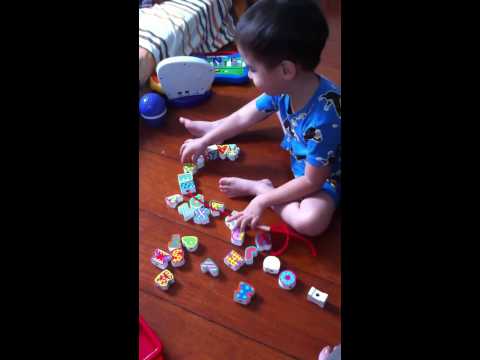
I asked Titus to string letters. He had to look for the letter and then put it on a string so they were facing the right direction.

Phonological Awarenesshttp://www.youtube.com/watch?v=EAnlFjjYVyM

Titus and I do Sing, Spell, Read, and Write together. I let him listen to the music so he learns the phonetic sounds of the letters. In this activity, I “tested” his knowledge of the sounds.


Easy Read-a-loud Book

Titus is enjoying this book now.We read a story a day and he is able to sit through it and pay attention. It’s called Stories Jesus Told by Nick Butterworth and Mick Inkpen and it is based on the parables of Jesus. I bought it at OMF Bookstore sometime ago for my older kids who also liked it.